
When a typical classroom packs twenty five to thirty children with just one teacher, even the most dedicated educator cannot provide continuous, focused attention. For a child with unique learning differences, this gap often means slipping behind quietly, term after term, without anyone catching the root issue until learning gaps become deep seated obstacles.
At Elite Scholar Academy, our educational philosophy is built on a clear principle: to truly teach children, educators must actively see them learning in real time, rather than guessing based on standardized tests weeks down the road.
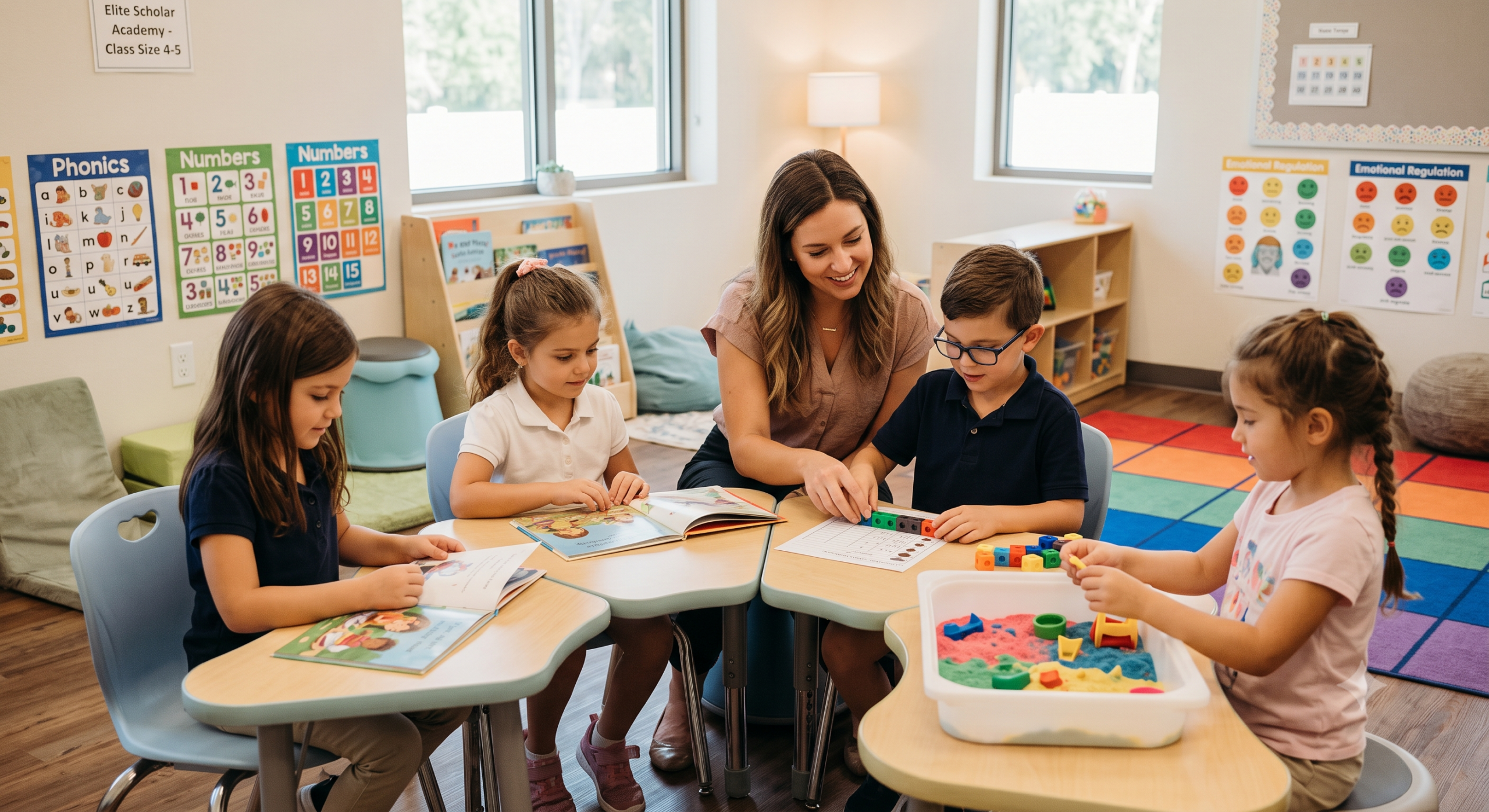
That is why every classroom at our Tampa private school caps enrollment at just 4 to 5 students per class. This micro class model is not a slogan. It is the cornerstone of how we deliver personalized education from early childhood through middle school. Whether preparing young minds in our Tampa Pre K programs or guiding students through our comprehensive 1st to 8th grade curriculum, our low student to teacher ratio ensures no learner gets lost in the crowd.
What Individualized Attention Actually Looks Like in Practice
Parents frequently hear the phrase “individualized instruction,” but large classroom environments rarely have the structural capacity to deliver it.
With only 4 to 5 peers in a room, real time observation replaces guesswork:
- Immediate Diagnostic Feedback: A teacher can watch how a child grips a pencil, sounds out complex phonemes, or breaks down multi digit addition. Misconceptions are corrected within seconds, preventing bad habits from setting in.
- Multi Sensory Adaptation on the Fly: If an abstract worksheet causes frustration, an instructor can instantly pivot to visual aids, tactile manipulatives, or storytelling without disrupting the rest of the group.
- Targeted Reinforcement: When a student faces a temporary roadblock in reading comprehension or executive functioning, our teachers can seamlessly integrate targeted interventions, such as customized intensive tutoring sessions, to solidify core competencies before moving forward.
Many children diagnosed with ADHD, mild autism spectrum differences, dyslexia, or auditory processing challenges do not struggle because they lack intellect. They struggle because rigid classrooms move at an inflexible pace, surrounded by twenty five other voices demanding the teacher’s focus. A micro class removes that friction entirely.
Four Reasons Special Needs Learners Thrive in Micro Classrooms
Every child benefits from dedicated attention, but exceptional learners experience transformative growth in small group settings:
1. Reduced Sensory Overload and Distraction
Large classrooms are dynamic, noisy, and visually cluttered environments. For students with sensory processing sensitivity or attention deficit profiles, filtering background hum, shifting chairs, and peripheral movement consumes substantial mental energy. A quiet, sensory friendly classroom of 4 or 5 children minimizes environmental fatigue, allowing children to direct their full cognitive focus toward academic discovery.
2. Truly Adaptive Pacing
In conventional schools, curriculum pacing is dictated by calendar deadlines, not mastery. If three students fail to grasp long division, the class moves forward regardless. In our micro class setting, pacing expands and contracts around student mastery:
- Concepts that demand extra reinforcement are given the time they require.
- Areas where a student shows accelerated aptitude are expanded with enrichment projects.
- No child endures the stigma of falling behind, and no child sits idle waiting for others to catch up.
3. Deep Emotional Safety and Rapport
Students who have struggled in previous school environments frequently carry school related anxiety. When a class has only 4 or 5 students, the teacher connects with each child as an individual by understanding their triggers, learning styles, special interests, and communication nuances. This bond of trust dismantles defensive behaviors, rebuilding self worth so students feel confident raising their hands and taking healthy academic risks.
4. Active Social and Emotional Growth
Socializing in massive groups can be overwhelming or lead to social isolation. In an intimate 5 student pod, teachers actively facilitate social interactions, peer collaboration, turn taking, and conflict resolution in a safe, guided setting.
Laying Concrete Foundations in Reading, Writing, and Math
Academic confidence begins with mastering essential literacy and numeracy. When core foundations in phonics, reading fluency, and basic operations are weak, every subsequent subject becomes an uphill battle.
- Explicit Literacy Instruction: We move past one size fits all reading curriculums. Some children thrive with multisensory phonics; others need structured decodables or interest driven text analysis. In a micro group, teachers can listen to every student read aloud daily.
- Structured Writing: Sentence construction begins with guided oral formulation, moving to tactile sentence frames, and graduating to structured paragraphs once confidence is earned.
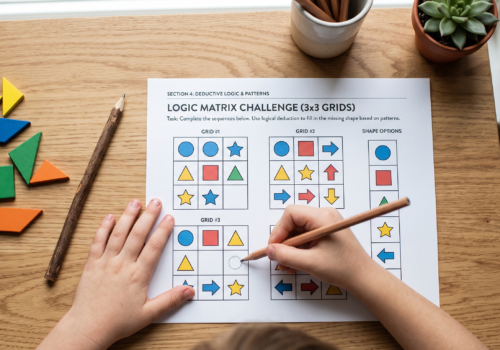
- Concrete to Abstract Mathematics: Math concepts are introduced through tactile manipulatives such as counters, rods, and geometric shapes long before formulas are written on paper, making abstract math intuitive and accessible.
For families whose students need focused, rapid remediation to bridge specific grade level gaps, pairing small daily classes with targeted after school or one on one tutoring accelerates progress significantly.
A Day in a 5 Student Classroom
Picture your child’s morning: instead of sitting at a crowded desk waiting for instructions, they gather around a small table with four peers.
During guided reading, each student reads aloud while the teacher listens closely, catching subtle phonological missteps and praising comprehension strategies immediately. Later, during math workshop, three students proceed with independent application problems while the instructor spends ten undivided minutes beside a fourth student, using physical manipulatives to illustrate regrouping.
There are no raised hands ignored, no hiding in the back row, and no unaddressed confusion. Every minute of the school day is meaningful and supportive.
Why Tampa Families Choose Elite Scholar Academy
Since 2013, Elite Scholar Academy has provided Tampa Bay families with an alternative to oversized public and traditional private classrooms. Serving students from early childhood through middle school across our foundational elementary and middle school programs, we maintain an intentional commitment to 4 to 5 student class environments.
We do not measure our success by expansive campus sizes, but by the measurable breakthroughs of our students: the hesitant reader who finally picks up a book with joy, the child with ADHD who discovers how to self regulate, and the student who walks through our doors eager to learn each morning.
Take the Next Step for Your Child
Learning should never feel like a high stress race against an inflexible system. If your child is struggling in a crowded setting or requires a specialized, supportive learning environment to flourish, discover what an intentional micro classroom can do.
Contact Elite Scholar Academy today to schedule your preliminary family interview and explore our Tampa campus.